Why Jack Arches?
Jack arches, built of fired brick and bearing themselves on steel girders are no ecological option of building a roof. They surely consume more embodied energy than a typical RCC slab. If designed well, the steel / concrete beams that support these jack arches can work as composite structures where the brick is in pure compression and the steel in tension, where further optimization can be gained.
It is a maintenance-free roof: When built on a slope, these work as a maintenance-free alternative to the typical Mangalore tiled roof. No need to change the tiles for life, no need to bother about monkeys/rain/wind dislodging your tiles. No need for purlins that rust. Nor worry about insects lodging themselves in between tiles. No entry of mosquitos. No entry of water. Almost double the thermal performance of a RCC Slab. It brings back the vernacular Mangalore tiled roof, without the need for a complicated sloping RCC structure.
The breathable, sound, and moisture-absorbing humility of a brick is compounded to protect and serve you well. If you believe that you want to build a space/home, that will leave an impact over more than a few generations, this method will make you fall in love with it.
Jack arches are surely faster than a typical RCC Slab, can be loaded almost immediately, and can be built with little / no skill by anyone.
Labor of the love, of building these with the free spanning method, if done in a DIY method, will make the system 50% cheaper than an RCC slab. But one cannot place a price on that labor ;-). The value of this skill will increase hand in hand with the increasing costs of steel and cement.
Need for such a workshop
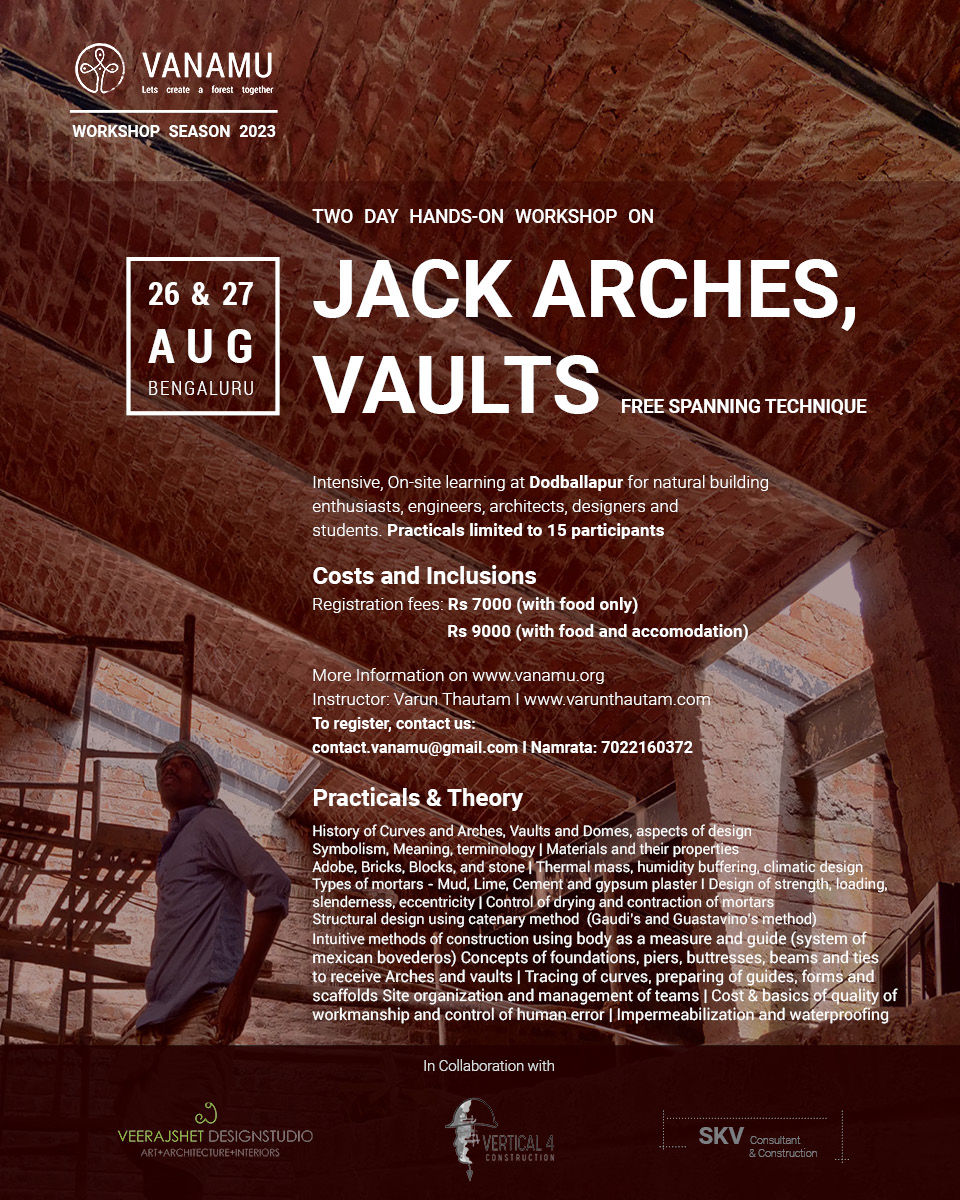
Over the past three years, we have been working with local masons to develop the skill of vaults and dome building with Lime-sukhi mortar. The free-spanning method is a lost skill that we are bringing back through these masons. A free-spanning method does not use shuttering, like conventional arches/vaults being built today. It is much stronger, as the individual arches lock in place while the mortar shrinks and sets. The curves are built by a mason with intuition, allowing a play of curves along different spans, allowing for expanding / contracting spans, with changing the rise of an arch. The
The free-spanning method needs a certain rational grounding, for anyone wanting to build a vault for a roof overhead. The workshop grounds you rationally and intuitively to be able to design and build small span arches, 3′ – 6′. It is the fundamental start of every “vault and dome” builder. Level 1, as my masters put it.
The site of Eng. Vijay Kumar of SKV Constructions, managed by Hemanth of Vertical 4 Construction and being designed by Ar.Veeraj Shet, allows us a practice space for 10-15 people working over two days to propagate this skill.
Background and source of knowledge.
My love for the art of building with vaults and domes started at the UNESCO Chair Earthen Architecture – Asia, Auroville back in 2008. Over the past 10 years, practicing as an architect-dome builder, I have risked the enthusiasm and trust that several clients have placed in me to experiment in their projects. Several of these experiments were aimed to unearth some of the pieces of the lost art of designing and building with vaults and domes.
When I came to Mexico, I had a very strong foundation on the scientific methods and tools used to design and build vaults and domes. Imagining and calculating curves under compression was a mathematical and geometrical approach – pure mathematics and physics. The past 5 years here in Mexico have been such a spectacular unlearning and learning process. The master vault and dome builders here surprised me with the compete intuitive approach to this – pure art. I have been closely observing the masters of Ar.Ramon Aguirre defy gravity with his Gaussian curves. There is Maestro Andres Flores (a third generation bovedero) who can build as effortlessly and imaginatively as an ant; as if his body and soul were connected with his creations. On the other hand there are masters like James Anthony who treat this artistic profession as meticulously and religiously as a spider builds a web. Using the body as a measure has helped then evolve a form to intuitive building, that cannot be easily explained by rational science. As their humble student, I am privileged to have been growing parallelly in the rational and the intuitive methods.
Back here in India, I’ve had the fortune of learning from the Master mason – Sonu Jangra of the Rohtak domes fame. His technique of flat domes is un-matched in the country, and possibly worldwide.
While I am no longer a professional vault and dome builder myself, workshops are an opportunity to pass on the experience gained. Maestro Andres says..sharing is the best method to learn and grow. I humbly take this opportunity to prepare myself to consolidate my learnings and seek opportunities to learn further through visits of artisans and learn from teachers who are willing to share. Below are a list of themes that can be explored in the workshop based on the turnout.
History of Curves and Arches | History of Vaults and Domes, examples and aspects of design | Symbolism, Meaning, terminology | Materials and their properties | Adobe, Bricks, Blocks, and stone | Thermal mass, insulation, humidity buffering, climatic design | Types of mortars – Mud, Lime, Cement and gypsum plaster | Concepts of structural design of Masonry, limit state| Design of strength, Loading, slenderness, eccentricity | Control of Safety and Reduction Coefficients | Control of drying and contraction of mortars | Structural Design and Calculations | Structural design using catenary method (Gaudi’s and Guastavino’s method) | Structural design using funicular method (Auroville Earth Institute) | Intuitive methods of construction using body as a measure and guide (system of mexican bovederos) | Concepts of foundations, piers, buttresses, beams and ties to receive Arches, vaults and domes | Construction and Organization of work | Tracing of curves, preparing of guides, forms and scaffolds | Site organization and management of teams | Basics of quality of workmanship and control of human error | Cost and time of construction | International codes and norms | Personal and shared experiences | Impermeabilization and waterproofing | Presentation of trials and errors | Presentation of work process of artisans around the world
See some videos on the free-spanning method from around the world Read more “Jack Arches”